
The Ultimate Reference
Rolex Movement Guide
Understanding Rolex Calibers, Innovation, and Evolution
A collector's guide to Rolex movements, the calibers that power them, and the evolution of the brand's most important mechanical systems.

1. The Complete Rolex Movement Timeline
Tap or hover a dot to preview. Click Learn More for full details.
Same color = same movement family lineage.
2. Rolex Movement Evolution by Complication
Rolex movements are developed in families, with different calibers designed around specific functions.
3. Rolex Caliber Guide
| Caliber | Years | Type | Power Reserve | Found In | Notes |
|---|---|---|---|---|---|
4030 |
1988–2000 | Automatic Chronograph | ~54 hours | Daytona 16520, Daytona 16523, Daytona 16528 | Based on the Zenith El Primero, heavily modified by Rolex. Powered the first automatic Daytona models. Historic significance for the Daytona lineup. |
3035 |
1977–1988 | Automatic (Date) | ~42 hours | Submariner Date 16800, Datejust 16030, Datejust 16233, Sea-Dweller 16660 | First Rolex automatic movement with quickset date function. Higher beat rate than its predecessor. Foundation for the 3135. |
3131 |
2007–2022 | Automatic (Time-Only) | ~48 hours | Air-King 116900, Milgauss 116400GV | Specialized no-date movement with enhanced anti-magnetic resistance. Featured paramagnetic escape wheel and Parachrom hairspring. |
3130 |
2001–2020 | Automatic (Time-Only) | ~48 hours | Submariner 14060M, Submariner 114060, Explorer 114270, Explorer 214270 | Previous-generation no-date movement. Closely related to the 3135 but without date complication. Respected for robustness and ease of service. |
4130 |
2000–2023 | Automatic Chronograph | ~72 hours | Daytona 116500LN, Daytona 116520, Daytona 116508, Daytona 116509, Daytona 116518LN | Rolex's first fully in-house chronograph. Simpler design than its predecessor with vertical clutch coupling. Powered the Daytona for over two decades. |
3186 |
2005–2018 | Automatic GMT | ~48 hours | GMT-Master II 16710, GMT-Master II 116710LN, GMT-Master II 116713LN, GMT-Master II 116718LN | Previous-generation GMT movement with Parachrom hairspring and independent hour hand adjustment. Replaced by the 3285 in 2018. |
3135 |
1988–2020 | Automatic (Date) | ~48 hours | Submariner Date 16610, Submariner Date 116610LN, Datejust 116234, Yacht-Master 16622, Sea-Dweller 16600 | One of Rolex's most celebrated movements. Produced for over 30 years; powered key sports models before being succeeded by the 3235. |
3230 |
2020–Present | Automatic (Time-Only) | ~70 hours | Submariner 124060, Oyster Perpetual 124300, Oyster Perpetual 126000, Explorer 124270, Explorer 224270, Air-King 126900 | Modern no-date movement with Chronergy escapement. Shares core technology with the 3235 but without a date complication. |
4131 |
2023–Present | Automatic Chronograph | ~72 hours | Daytona 126500LN, Daytona 126508, Daytona 126509, Daytona 126518LN, Daytona 126519LN | Latest Daytona movement. Builds on the 4130 with improved efficiency, redesigned chronograph system, and Paraflex shock absorbers. |
3255 |
2015–Present | Automatic Day-Date | ~70 hours | Day-Date 36 128238, Day-Date 36 128239, Day-Date 40 228238, Day-Date 40 228239, Day-Date 40 228235 | Rolex's flagship movement, developed exclusively for the Day-Date collection with the Chronergy escapement and Parachrom hairspring. |
3285 |
2018–Present | Automatic GMT | ~70 hours | GMT-Master II 126710BLRO, GMT-Master II 126710BLNR, GMT-Master II 126720VTNR, GMT-Master II 126715CHNR, GMT-Master II 126711CHNR | Modern GMT movement with independently adjustable hour hand and Chronergy escapement. Replaced the 3186. |
3235 |
2015–Present | Automatic (Date) | ~70 hours | Datejust 41 126300, Datejust 41 126334, Submariner Date 126610LN, Submariner Date 126613LB, Sea-Dweller 126600, Yacht-Master 126622 | Replaced the 3135 with improved efficiency, longer power reserve, and the Chronergy escapement. One of Rolex's most widely used modern movements. |
4. Understanding Rolex Watch Movements
What is a Watch Movement?
A watch movement, also known as a caliber, is the internal mechanism that powers the watch and drives its functions. In Rolex watches, movements are developed and manufactured in-house for accuracy, reliability, and long-term durability.
Types of Watch Movements
Powered by a battery. Known for accuracy and low maintenance.
Wound by hand using the crown to store energy in a mainspring.
Wound by a rotor that moves with your wrist to power the watch.
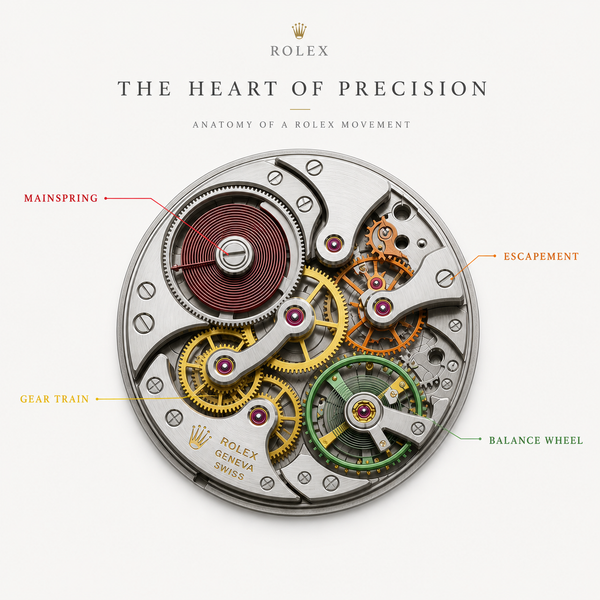
Key Components of a Watch Movement
- 1Mainspring — Stores and releases energy.
- 2Gear Train — Transfers energy through a series of gears.
- 3Escapement — Releases energy in small, consistent steps.
- 4Balance Wheel — Oscillates at a constant rate to keep accurate time.
How a Watch Movement Works: A Mechanical Orchestra
Think of a watch movement as a mechanical orchestra. The mainspring is the conductor, the gear train carries the music, and the escapement with the balance wheel keeps perfect rhythm.
 Energy Stored
Mainspring wound
 Energy Released
Mainspring unwinds
 Energy Transferred
Transferred through the gear train
 Energy Regulated
Escapement releases energy